⁂
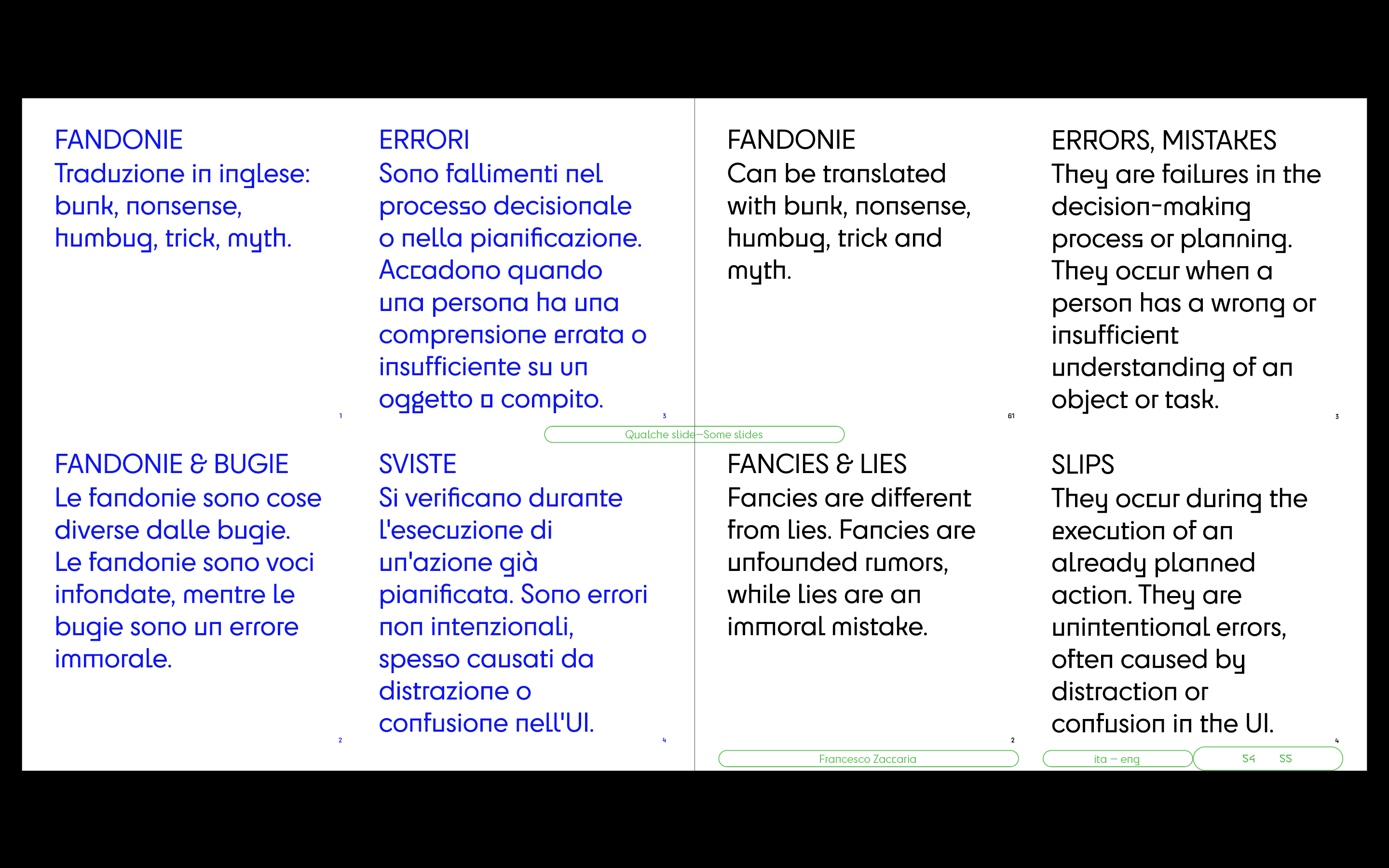
Fandonie
A magazine on artificial intelligence, errors and myths to debunk.
The magazine
The first issue of Fandonie: a journey through mechanical automatons, experimental kittens, technological alienation and the frame as an act of salvation. In Italian and English.
#01 Framing the Machinic: Towards a Salvific Hermeneutics of the Limit
Debunking the Myth
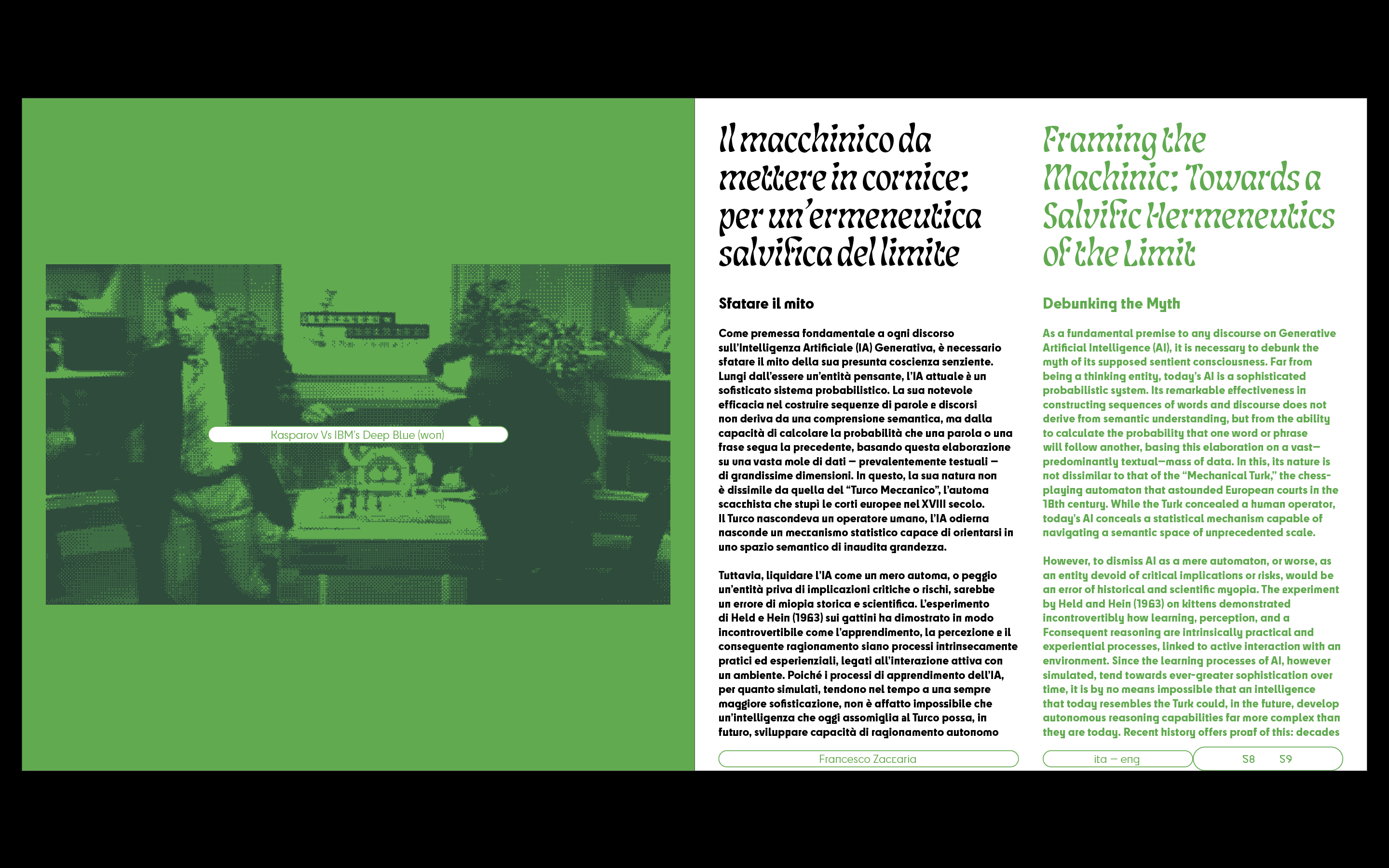
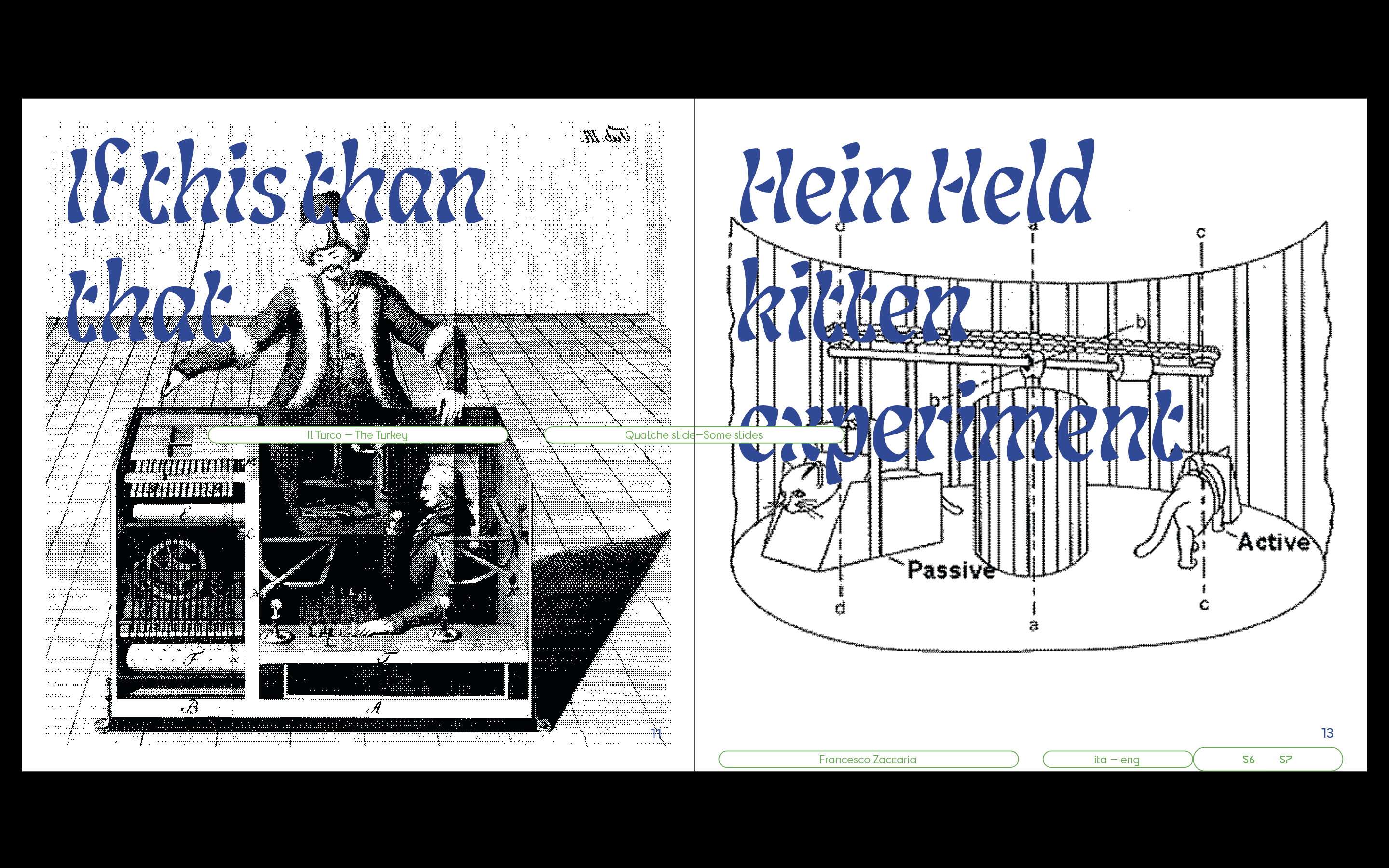
As a fundamental premise to any discourse on Generative Artificial Intelligence (AI), it is necessary to debunk the myth of its supposed sentient consciousness. Far from being a thinking entity, today's AI is a sophisticated probabilistic system. Its remarkable effectiveness in constructing sequences of words and discourse does not derive from semantic understanding, but from the ability to calculate the probability that one word or phrase will follow another, basing this elaboration on a vast — predominantly textual — mass of data. In this, its nature is not dissimilar to that of the "Mechanical Turk," the chess-playing automaton that astounded European courts in the 18th century. While the Turk concealed a human operator, today's AI conceals a statistical mechanism capable of navigating a semantic space of unprecedented scale.
However, to dismiss AI as a mere automaton, or worse, as an entity devoid of critical implications or risks, would be the error of historical and scientific myopia. The experiment by Held and Hein (1963) on kittens demonstrated incontrovertibly how learning, perception, and consequent reasoning are intrinsically practical and experiential processes, linked to active interaction with an environment. Since the learning processes of AI, however simulated, tend towards ever-greater sophistication over time, it is by no means impossible that an intelligence that today resembles the Turk could, in the future, develop autonomous reasoning capabilities far more complex than they are today. Recent history offers proof of this: decades have passed since 1997, when the IBM computer Deep Blue defeated the world chess champion Garry Kasparov, marking a fundamental milestone in the computational ability to solve complex problems.
From Cultural Metaphor to Technological Alienation
This trajectory of growing capability is grafted, at least in the collective West, onto an already fertile cultural ground. For over a century, countless literary and cinematic authors, from Isaac Asimov to Philip K. Dick, have investigated the theme of sentient and intelligent non-human subjects. Our collective metaphors, our imagination, have been trained for decades to conceive the existence of "other" intelligences and, at times, to fear them (Notte, 2005).
Nevertheless, the metaphors we use today to describe technology are often misleading, flawed by celebratory or, at times, even propagandistic traits (Chomsky, 2023). The case of the "cloud" is emblematic: an ethereal and light term that masks the reality of one of the planet's heaviest industries, made up of energy-intensive data centers that require immense water and electrical resources, with a dramatic environmental impact (Bridle, 2019). For many significant voices in the intellectual landscape, this semantic opacity is not innocent; it serves to hide the material cost of our digital dematerialization (Zuboff, 2019).
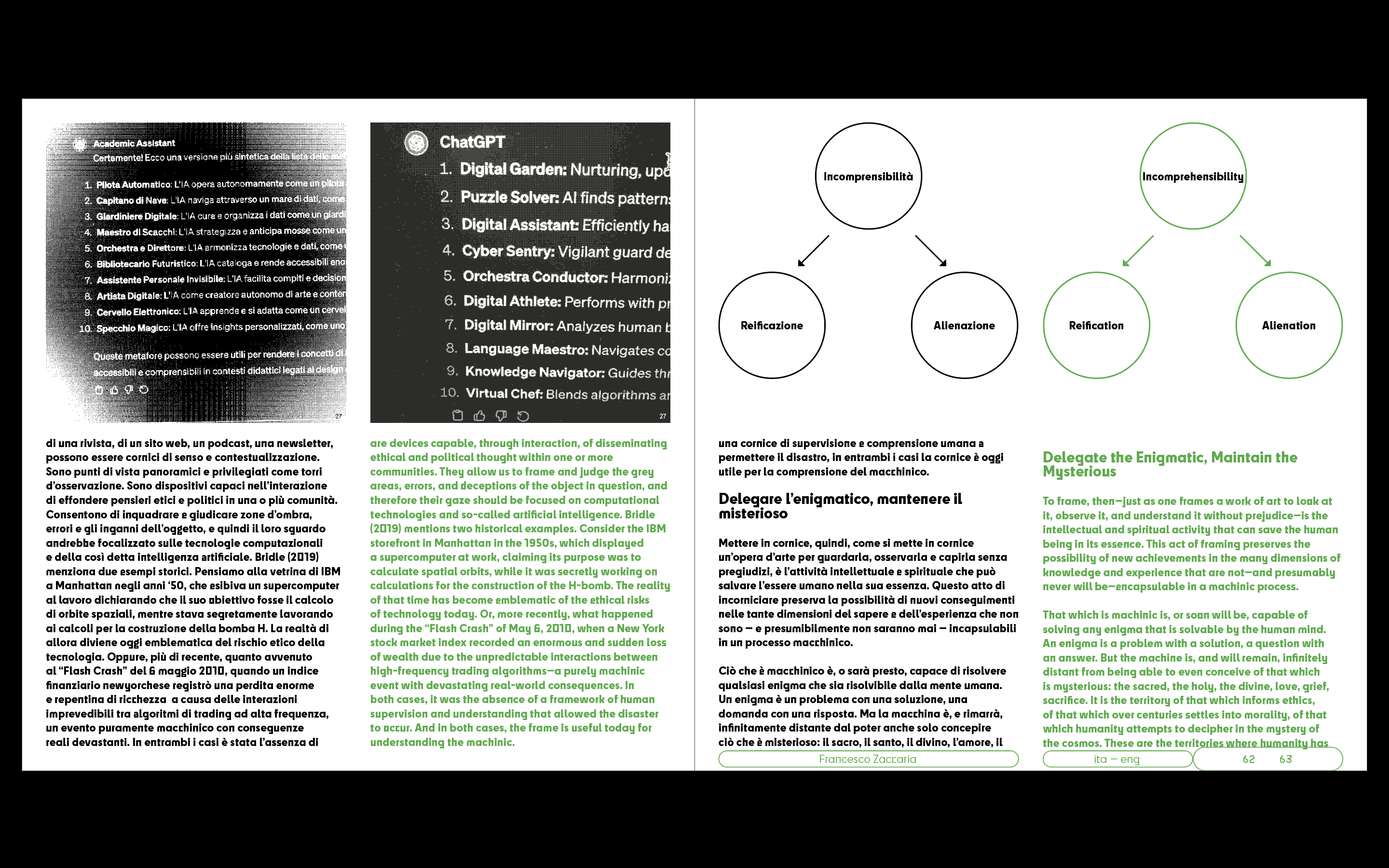
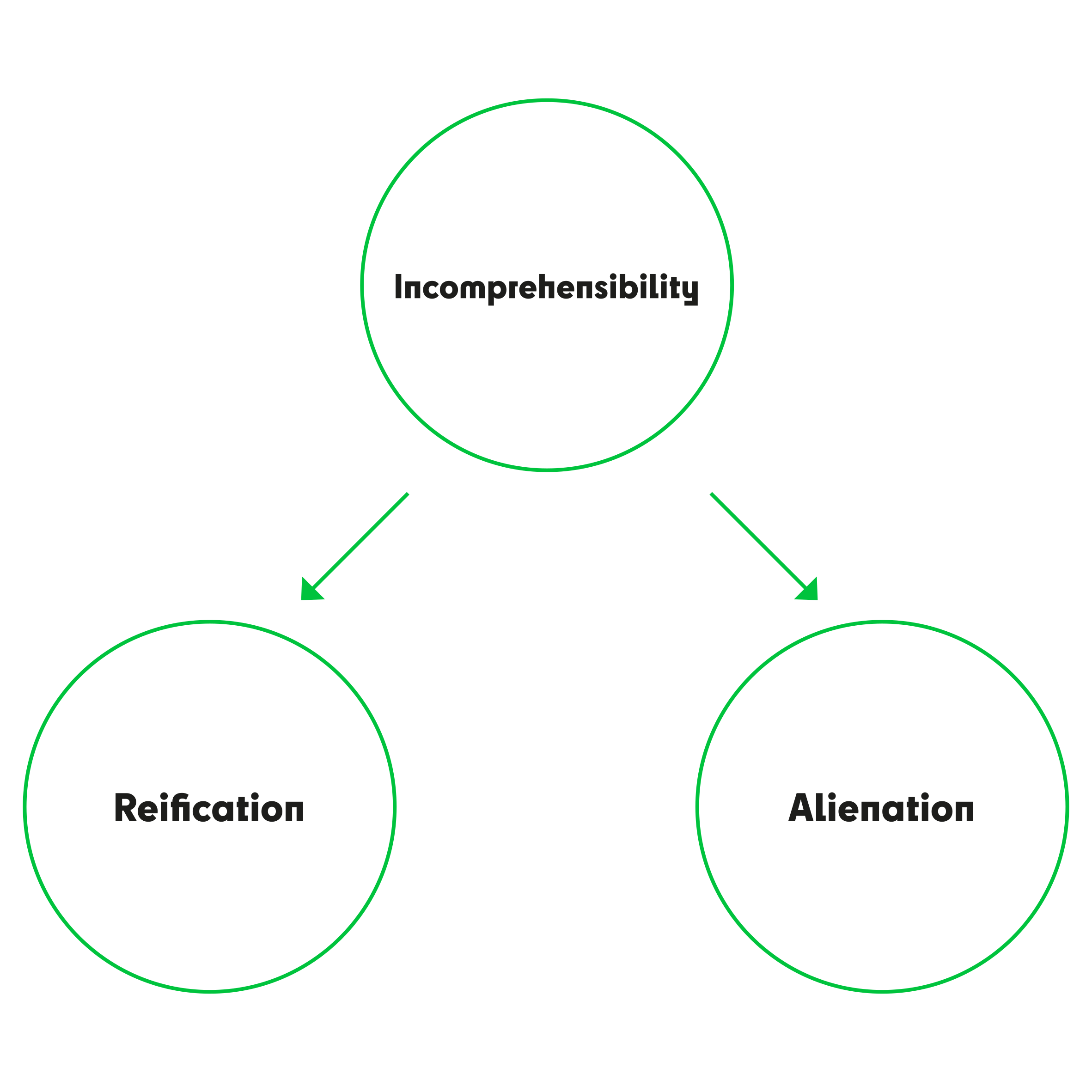
The deepest risk, however, transcends economic and ecological impacts to touch the core of human experience: alienation. Although this danger has been perceived with varying degrees of lucidity by many thinkers, from Kant to Heidegger, it is in its connection with the concepts of reification and the sacred that it reveals its most radical implications, as theorized by Umberto Galimberti long before the recent advent of generative AI. This analysis finds echoes in ancient myths, like that of Prometheus chained for having given fire (techne) to humans — myths that help us reason about the essential relationship between the human and the machinic. The danger is that of stepping outside the perimeter of what is human, creating an anthropology in which the relationship between the sphere of the human and that of the biological becomes increasingly fractured and problematic, with disastrous effects on individual well-being. In the alienation delineated by Umberto Galimberti in Psiche e téchne (1999), the technical apparatus is no longer a tool in human hands, but an environment that envelops and determines us, transforming the human into a mere cog, devalued in its importance and sacredness. If for Galimberti it was information technology that triggered this process, today AI takes it to a higher level: the machine, thanks to its immense computational power, does not merely employ technique, but dominates other sciences — mathematics, biology, statistics — to extend new purposes that deepen the sense of expropriation of the human domain in favor of the machinic one.
In parallel, these immanent mechanisms contribute to redefining the very idea of the sacred, emptying the human of its transcendent dimension while deifying that which is machinic — like the metropolis — and, at times, the machine itself. The algorithm becomes the new oracle and software code the new sacred scripture, in a process of transferring faith from the human to the artificial.
The Frame as an Act of Salvation
Faced with this scenario, the question of the "frame," as understood by the sociologist Georg Simmel in a short 1902 essay, emerges as crucial. For Simmel, a picture's frame is not a simple ornament but a fundamental epistemological device: it separates the work of art from the surrounding reality, creating an autonomous space of meaning and allowing the subject to perceive it as art. It is an analogy that evokes the almost desperate need for a conceptual, ethical, and critical frame that allows us to discern between the real and the artificial, between the human and the product of machines.
This frame is not an abstract concept, but a practical tool for judgment. The frame of an exhibition, a magazine, a website, a podcast, or a newsletter can all serve as frames of meaning and contextualization. They are panoramic and privileged viewpoints, like observation towers. They are devices capable, through interaction, of disseminating ethical and political thought within one or more communities. They allow us to frame and judge the grey areas, errors, and deceptions of the object in question, and therefore their gaze should be focused on computational technologies and so-called artificial intelligence. Bridle (2019) mentions two historical examples. Consider the IBM storefront in Manhattan in the 1950s, which displayed a supercomputer at work, claiming its purpose was to calculate spatial orbits, while it was secretly working on calculations for the construction of the H-bomb. The reality of that time has become emblematic of the ethical risks of technology today. Or, more recently, what happened during the "Flash Crash" of May 6, 2010, when a New York stock market index recorded an enormous and sudden loss of wealth due to the unpredictable interactions between high-frequency trading algorithms — a purely machinic event with devastating real-world consequences. In both cases, it was the absence of a framework of human supervision and understanding that allowed the disaster to occur. And in both cases, the frame is useful today for understanding the machinic.
Delegate the Enigmatic, Maintain the Mysterious
To frame, then — just as one frames a work of art to look at it, observe it, and understand it without prejudice — is the intellectual and spiritual activity that can save the human being in its essence. This act of framing preserves the possibility of new achievements in the many dimensions of knowledge and experience that are not — and presumably never will be — encapsulable in a machinic process.
That which is machinic is, or soon will be, capable of solving any enigma that is solvable by the human mind. An enigma is a problem with a solution, a question with an answer. But the machine is, and will remain, infinitely distant from being able to even conceive of that which is mysterious: the sacred, the holy, the divine, love, grief, sacrifice. It is the territory of that which informs ethics, of that which over centuries settles into morality, of that which humanity attempts to decipher in the mystery of the cosmos. These are the territories where humanity has always erred and always will, where no reliable solution exists. But it is precisely the frame we give to this fallible thinking — the frame of ritual, of faith, of art, of philosophy — that saves it, allows its survival, and defines its inestimable value. The path to salvation, therefore, does not lie in rejecting the automaton or the machinic, as they are now part of our survival. The salvation of the human lies in our constant and deliberate act of framing them.
Sources
- Bridle, James. New Dark Age: Technology and the End of the Future. (Italian edition: Nuova era oscura, 2019, Nero, Rome).
- Chomsky, Noam. "The False Promise of ChatGPT", The New York Times, March 8, 2023.
- Galimberti, Umberto. Psiche e techne (Psyche and Techne), 1999, Feltrinelli, Milan.
- Notte, Riccardo. You Robot, 2005, Vallecchi, Florence.
- Zuboff, Shoshana. The Age of Surveillance Capitalism: The Fight for a Human Future at the New Frontier of Power, 2019. (Italian edition: Il capitalismo della sorveglianza, 2023, Luiss, Rome).
The author
Visual communication designer, front-end developer, and UI Design Professor at NABA Milan. Since 2011, his professional path has woven together strategic communication, graphic design, code, and, more recently, artificial intelligence. He tenaciously leads the branding and communication studio Masterismi.com, driven by the ambition to follow in the footsteps of his masters. He is the founder of ABCity.org, a traveling project focused on creativity and social impact, and the creator of Fandonie, a magazine exploring AI errors and hallucinations.
Host the next issue
Fandonie is looking for an editorial team, institution or cultural space to host and curate the next issue. Get in touch to apply.